Ski Hostel vs weski.com: Is a ski package cheaper in Europe?
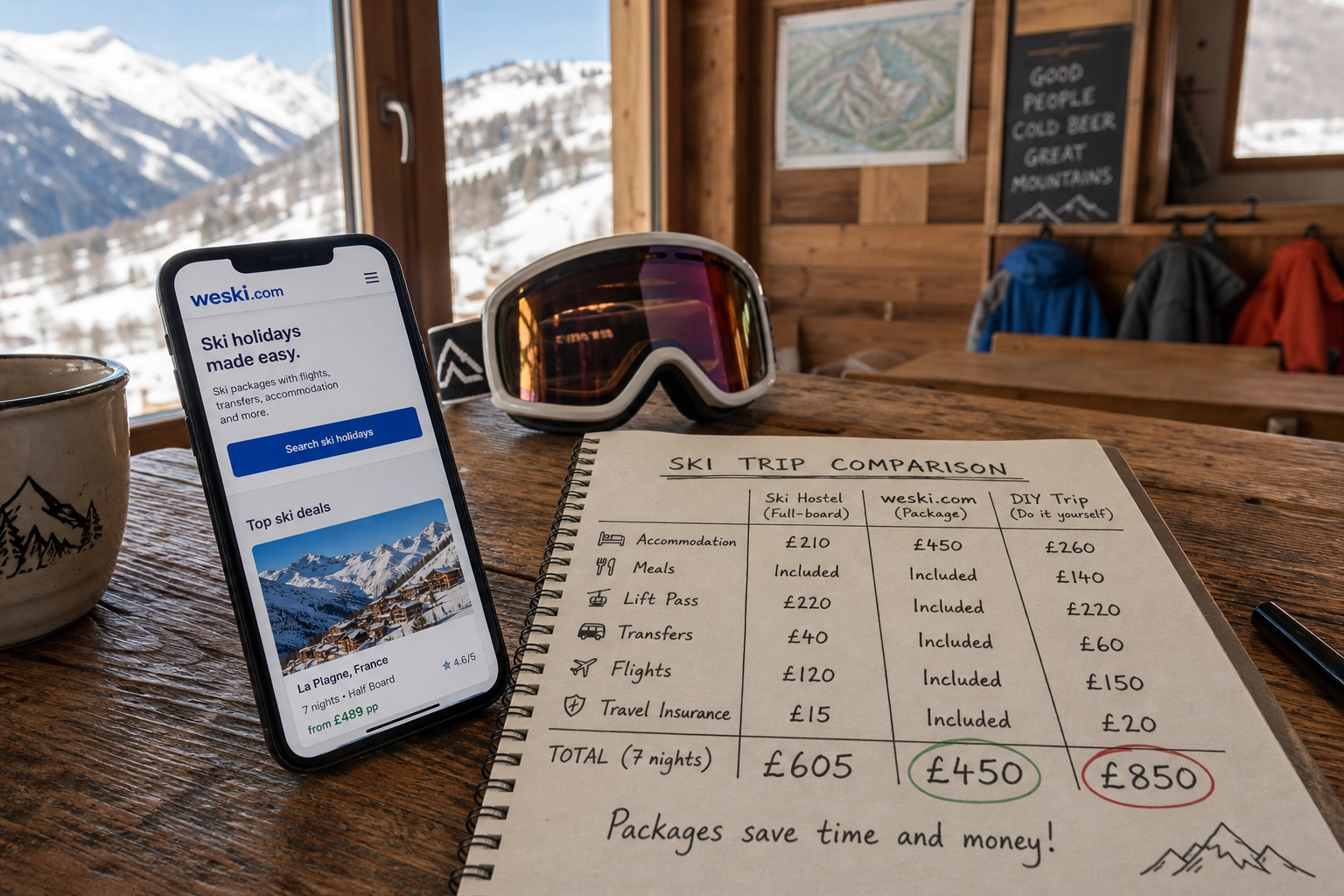
Anyone who has ever tried to piece together a European ski holiday knows the exact moment panic sets in. You find a cheap Ryanair or easyJet flight to Geneva, feel a brief rush of victory, and then open a new tab to look at accommodation, lift passes, and train transfers. Suddenly, your “budget” weekend in the Alps has spiraled past €1,500 before you have even factored in a single plate of mountain fondue or a post-ski beer.
The complexity and hidden costs of European ski logistics have created a massive market for packaged ski holidays. Historically dominated by traditional high-street tour operators, the market is now split between modern online travel agencies (OTAs) like weski.com and specialized, fixed-base operators like Ski Hostel.
For budget-conscious skiers, solo travelers, and digital nomads, the overriding question is always the same: Is it actually cheaper to book a bundled ski package, or should you build the trip yourself?
To answer that, we need to dismantle how ski pricing actually works in Europe, compare the algorithm-driven OTA model of weski.com against the fixed-base community model of Ski Hostel, and look at the hidden financial traps that catch independent travelers off guard.
The Invisible Costs of a European Ski Trip
When you look at a ski trip on paper, you usually calculate three things: flights, a bed, and a lift pass. In reality, a European ski holiday is an ecosystem of micro-transactions. If you fail to account for them, your DIY budget will collapse on day two.
Mountain-Town Inflation
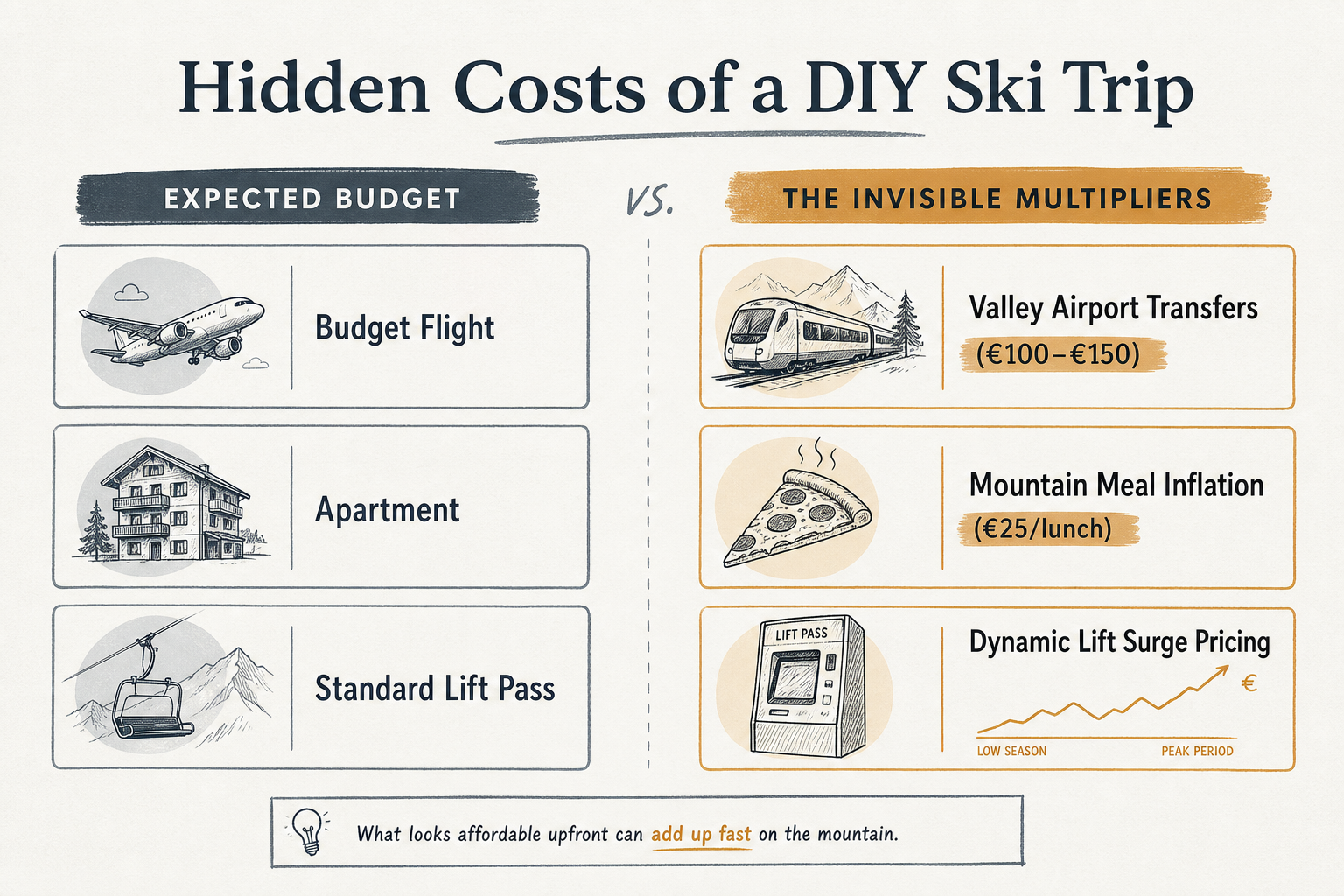
Resort towns operate as captive economies. A standard margherita pizza that costs €10 in Milan or Munich will easily cost €25 in Zermatt, Val Thorens, or St. Anton. Supermarkets in these alpine villages carry steep markups because of the logistical difficulty of transporting goods up the mountain. If you book an Airbnb to save money, you will still pay a premium for basic groceries.
The Transfer Trap
Budget airlines fly into major hubs—Geneva, Zurich, Lyon, or Innsbruck. However, ski resorts are located at the end of long, winding, icy valleys. Transportation from the airport to the resort is rarely cheap. As highlighted in A Beginner’s Guide to Planning a Ski Holiday, organizing airport transfers is a critical early step, as failing to book reliable transport from the airport to your resort can leave you stranded or at the mercy of exorbitant last-minute taxi fares. Private transfers or shared shuttle buses are reliable, but beware of the costs associated with getting to remote alpine bases, a logistical reality noted in Definitive Guide: European Ski Destinations. A round-trip train ticket from Geneva to a major Valais resort can easily add €100 to €150 to your baseline cost.
Dynamic Lift Pass Pricing
Ten years ago, a lift pass had a fixed price for the season. Today, major European mega-resorts use airline-style dynamic pricing. If you wait until you arrive to buy your pass for a busy February week, you will pay the absolute maximum rate.
These invisible costs are exactly why package holidays exist. By bundling components, providers shield you from the daily friction of mountain inflation. But not all packages are built the same. Let us look at the two dominant modern models: the OTA aggregator (weski.com) and the direct operator (Ski Hostel).
The Weski.com Model: Algorithmic Aggregation
Weski.com represents the modern evolution of the ski travel agency. Rather than owning hotels or operating buses, Weski acts as a sophisticated digital aggregator.
How Weski Works
When you plug your dates and destination into Weski, their backend connects to global bedbanks (massive wholesale hotel inventory databases), flight APIs, transfer companies, and regional lift ticket operators. The platform dynamically stitches these separate elements into a single checkout flow.
The Advantages of the OTA Approach
The primary advantage of Weski is scale and customization. If you have a group of ten people flying from three different countries who want to stay in a specific 4-star hotel in Chamonix, Weski allows you to coordinate that in one dashboard.
You can toggle flights on and off, upgrade equipment rentals, and browse hundreds of resorts across France, Austria, Switzerland, and Italy. For the traveler who wants to ski a famous mega-resort and wants the convenience of a single booking reference, it is a highly effective tool.
The Drawbacks of Aggregation
The limitation of the Weski model is that it is fundamentally an intermediary. Weski does not own the chalets, they do not cook the food, and they do not drive the shuttles.
Because they are aggregating inventory from major, famous resorts, you are still paying mainstream mega-resort prices. Weski might get a slight wholesale discount on a hotel room in Val d’Isère, but Val d’Isère is still one of the most expensive places on earth. Furthermore, as an aggregator, Weski must build a margin into the package to turn a profit.
Most importantly for budget travelers, Weski packages typically bundle accommodation, flights, passes, and transfers, but they rarely include food. You are still left to navigate the €25 mountain pizzas and the €8 hot chocolates on your own.
The Ski Hostel Model: Fixed-Base Community
Ski Hostel operates on a completely different model. Rather than aggregating third-party inventory across hundreds of resorts, Ski Hostel owns and operates a specific, physical basecamp: the Relais de Dranse in Liddes, Switzerland.
How Ski Hostel Works
Ski Hostel provides an all-inclusive, fixed-base experience specifically designed for budget-conscious skiers, solo travelers, and digital nomads. Instead of dropping you into a hyper-expensive mega-resort, the hostel is located in the authentic, quieter Valais region.
A standard 6- or 7-night package bundles everything at the source. It includes hostel-style lodging, full-board dining (breakfast, packed lunch, and dinner), daily mountain shuttle transfers, and ski lift passes for three nearby, high-quality Swiss Alps resorts: Vichères-Liddes, La Fouly, and Champex-Lac.
The Advantages of the Direct Basecamp
Because Ski Hostel controls the accommodation, the food, and the transport, they completely remove the alpine markup. You do not have to worry about the cost of a mountain lunch because you are handed a packed lunch in the morning. You do not have to worry about navigating Swiss trains with heavy ski bags because the daily shuttle drives you from the front door to the chairlift.
Furthermore, by utilizing three smaller, high-altitude Swiss resorts rather than the overcrowded mega-resorts, the cost of the lift pass is fundamentally lower. You still get incredible Swiss Alps powder, empty pistes, and massive freeride terrain, but without the premium charged by places like Zermatt.
For a deeper understanding of how to make this specific region work for your budget, read How to plan an affordable ski trip in the Swiss Alps.
The Built-in Social Ecosystem
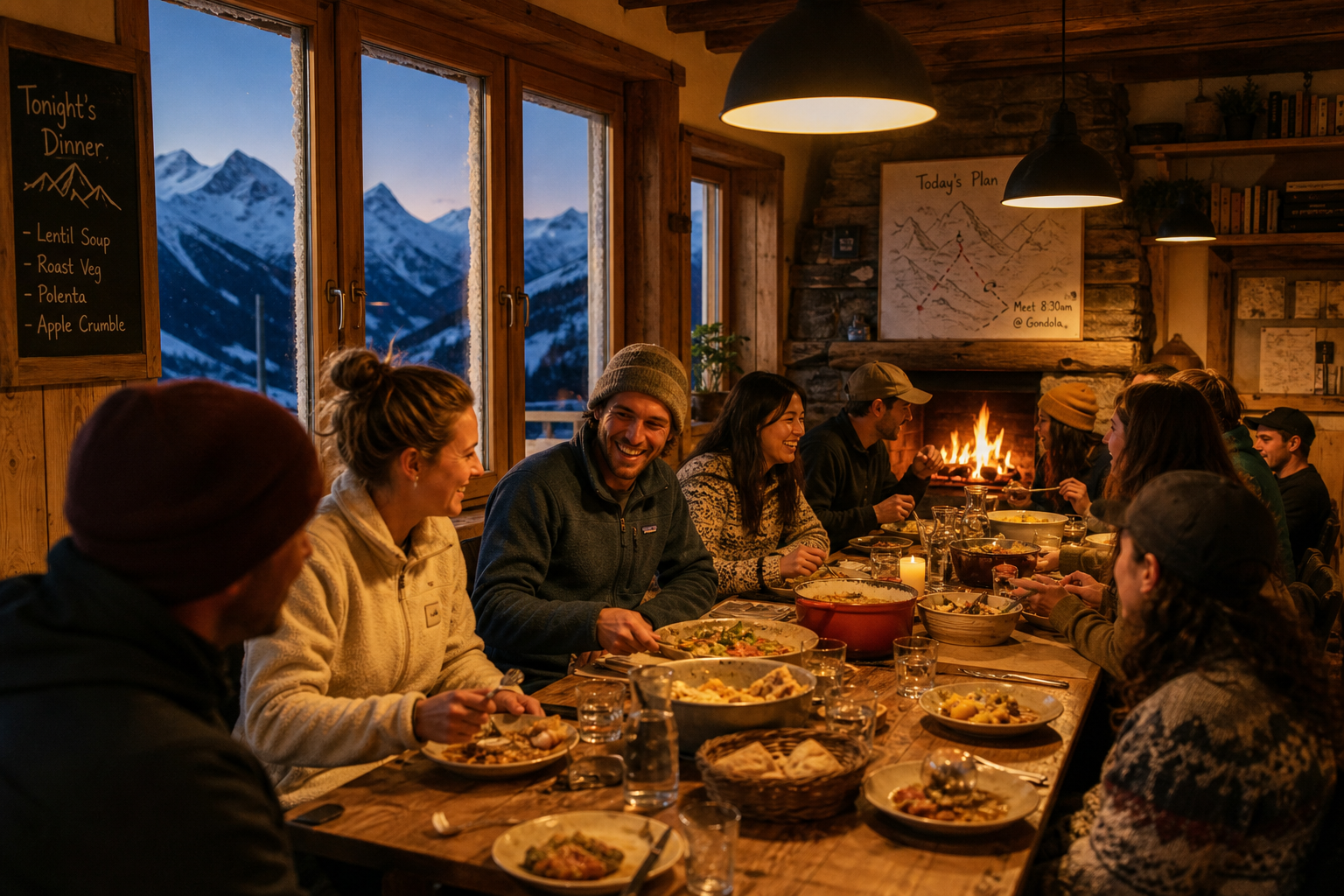
The other major differentiator is the community. When you book a cheap apartment via an OTA, you are completely isolated. At a dedicated ski hostel, the environment is engineered for social connection. Solo travelers and digital nomads eat together, ride the shuttle together, and ski together.
Direct Cost Comparison: DIY vs. Weski vs. Ski Hostel
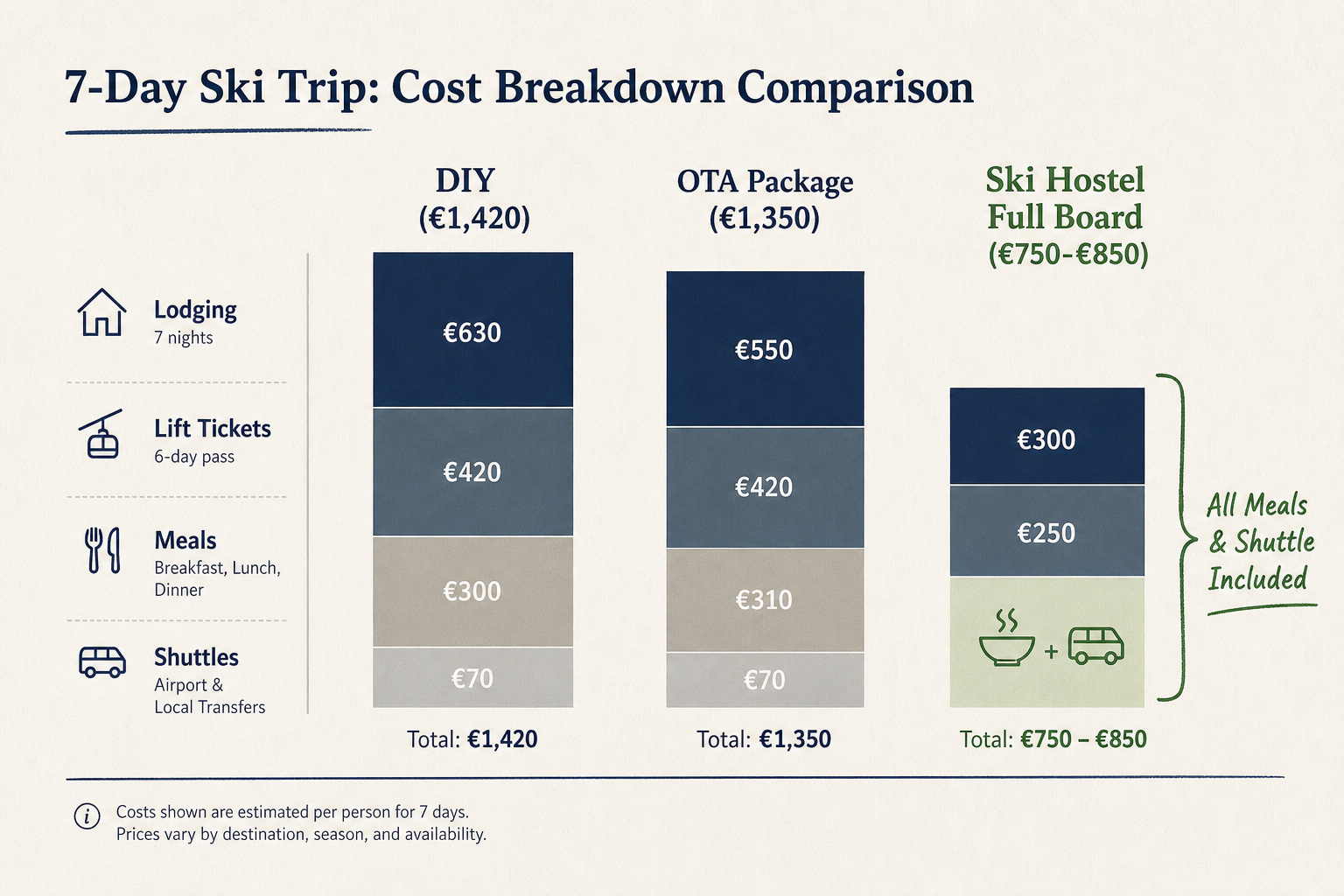
To truly answer whether a ski package is cheaper in Europe, we need to look at the math. Below is a realistic, comparative cost estimation for a 7-night ski trip for a single adult during a standard winter week (excluding flights, as origin cities vary).
| Expense Category | DIY (Mainstream Resort) | Weski.com (Mainstream Resort) | Ski Hostel (Valais, Switzerland) |
|---|---|---|---|
| Accommodation (7 nights) | €450 (Basic Airbnb) | Bundled in total | Bundled in total |
| Lift Pass (6 days) | €350 (Dynamic/Walk-up) | Bundled in total | Bundled (3 resorts) |
| Transfers (Airport to Base) | €120 (Train/Bus) | Bundled in total | Optional Add-on (approx €100) |
| Breakfast (7 days) | €70 (Self-catered) | €100 (Hotel add-on) | Included (Full Board) |
| Lunch (6 days) | €150 (Mountain cafes) | €150 (Mountain cafes) | Included (Packed Lunch) |
| Dinner (7 days) | €250 (Modest dining) | €250 (Modest dining) | Included (Cooked dinners) |
| Daily Ski Transport | €30 (Local ski bus) | €30 (Local ski bus) | Included (Private shuttle) |
| Total Estimated Cost | €1,420 | €1,350 (Package + Food) | Starts around €750 - €850 |
Note: Prices are estimates based on standard 2025/2026 winter season rates. DIY and OTA models assume mainstream alpine resorts (e.g., French Tarentaise or Austrian Tirol). Ski Hostel rates reflect standard package pricing.
Analyzing the Numbers
When comparing Weski to a pure DIY approach, the OTA package often wins by a narrow margin—perhaps €50 to €100 in savings. Weski’s algorithmic bundling secures wholesale rates that slightly undercut booking everything independently, and it saves you hours of frustrating research.
However, the real cost driver of a ski holiday is not just the bed and the lift pass; it is keeping yourself alive and fed on a mountain for a week.
Because Weski packages rarely include lunch and dinner, you are fully exposed to resort-town food prices. Ski Hostel undercuts both models dramatically because of the full-board inclusion. By controlling the kitchen and providing three meals a day, they eliminate the most volatile part of a ski budget.
If you are debating the value of having your meals covered, our breakdown on Half board vs full board for an active ski holiday explains exactly how many calories you burn at altitude and why relying on mountain restaurants drains budgets so quickly.
Is It Cheaper to Book an All-Inclusive Ski Package or Buy Separately in Europe?
This is one of the most common questions typed into search engines by winter travelers, and the answer requires a bit of nuance based on timing and definition.
The Peak Season Reality
During peak periods—Christmas, New Year, and the dreaded February half-term when schools across Europe let out—all-inclusive or bundled ski packages are almost always cheaper than buying separately.
During these weeks, independent accommodation inventory vanishes, and algorithms drive prices sky-high. Tour operators and package providers hold pre-negotiated contracts for beds and lift passes. They lock in their inventory months in advance, protecting the buyer from the worst of peak-season surge pricing.
The Off-Peak DIY Window
In quieter periods—specifically the middle of January and early to mid-March—independent booking can sometimes beat OTA packages. If you are willing to scour the internet for last-minute self-catering apartment cancellations and hunt down early-bird lift pass deals, a highly organized DIY traveler might save €50 to €150 over a Weski package.
As noted in budget travel circles, securing accommodation with a kitchen is a primary tactic for DIY savings; 10 Tips for a Budget-Friendly Ski Vacation highlights that having a space to cook allows you to avoid expensive restaurant meals entirely.
The Full-Board Advantage
However, the “DIY vs Package” debate changes entirely when you introduce a direct, full-board operator like Ski Hostel. Even in the dead of January, a DIY traveler paying for groceries, a multi-day mega-resort lift pass, and train transfers will struggle to match the flat rate of a Ski Hostel package. The economies of scale achieved by a hostel cooking for 40 guests simply cannot be replicated by one person cooking in a cramped Airbnb kitchenette.
What to Look For When Choosing a Ski Hostel in Europe
If you decide to step away from the mainstream OTAs and look for a dedicated ski hostel, you have to be careful. The word “hostel” in Europe can mean anything from a luxurious, purpose-built digital nomad hub to a freezing, repurposed 1970s youth camp.
When evaluating a European ski hostel, a cheap bed is useless if the logistics ruin your trip. Here is exactly what you need to evaluate before booking.
1. Location and Slope Access
The most critical factor is how you actually get to the snow. A hostel marketed as “near the ski area” can mean it is a five-minute walk, or it can mean it is a 45-minute public bus ride away with transfers.
Look for one of two things:
- Walking distance to lifts: Ideal, but highly expensive and rare for true budget hostels.
- Dedicated private shuttle: This is the golden ticket. A hostel that operates its own shuttle van (like Ski Hostel does to Vichères-Liddes, La Fouly, and Champex-Lac) guarantees you will not be standing in the freezing rain waiting for a delayed public postbus.
2. Ski-Specific Facilities
A summer backpacking hostel cannot easily convert to a winter ski hostel without the right infrastructure. Winter sports generate vast amounts of wet, heavy, bulky gear. If a hostel does not have the infrastructure to manage this, your room will quickly smell like damp wool and misery.
Ensure the hostel offers:
- Heated boot dryers: Putting on frozen, wet boots at 8:00 AM will ruin your day before it begins. Boot dryers are non-negotiable.
- Secure ski/snowboard storage: You cannot drag €800 skis into a dorm room.
- Drying rooms: A dedicated, heated space for wet jackets, salopettes, and gloves.
3. Lift Pass Logistics
Look for properties that integrate the skiing directly into their service. Can you secure your pass through them? Some of the best alpine lodgings offer seamless pass integration. For example, Sporthotel Alpina notes that purchasing ski passes directly at reception allows guests to avoid lift queues and start their day immediately, a convenience similarly echoed by Hotel Euroski. Ski Hostel takes this a step further by simply including the pass in the package, meaning you never have to visit a ticket window at all.
4. The Atmosphere and Demographics
Ski hostels vary wildly in their vibe. Some are notorious party houses aimed at 19-year-old university students. Others are quiet, remote cabins.
Read reviews carefully to understand who stays there. Are you a 30-something digital nomad looking to ski hard all morning, work on a laptop in the afternoon, and have a quiet beer by the fire at night? If so, you do not want to be in a hostel famous for 3:00 AM table dancing.
To understand who you will likely be sharing the common room with, check out our deep dive into European ski hostel guest demographics and age range profile.
Top Hostels for Solo Travelers Wanting to Ski in Europe
Solo travelers face the toughest financial penalty in the ski world. Hotel rooms are priced on double occupancy, and renting an entire apartment for one person is financially disastrous.
For solo skiers, the goal is not just finding a cheap bed; it is finding people to ride with. Skiing alone, particularly off-piste, is dangerous. You want an environment that naturally fosters connections.
The Power of Communal Dining
The absolute best hostels for solo travelers are those that enforce communal dining. When a hostel operates on a half-board or full-board basis with large, shared tables, you are guaranteed to meet people.
This model of socialization is incredibly effective. For instance, a Prague Hostel Stay Review highlighted how a hostel organizing family-style dinners successfully brings dozens of strangers together around a big table every evening. When this exact concept is applied to a ski basecamp like Relais de Dranse, you sit down to a hot dinner, ask the person across from you how their day on the mountain was, and instantly have a ski buddy for the next morning.
Avoiding the Youth Hostel Trap
Many solo travelers mistakenly book standard city-style youth hostels that happen to be located near a mountain. This is often a mistake. These venues are filled with transient tourists who may not even be there to ski.
Instead, look for specialized sports hostels. If you want to understand the stark difference between a purpose-built winter sports basecamp and a generic backpacker dorm, read our guide on Ski hostel packages vs youth hostels in Valais.
Hidden Traps of DIY European Ski Trips
If you are still leaning toward skipping packages altogether and building a DIY trip, you must navigate several common traps that regularly blow up independent budgets.
The Baggage and Gear Penalty
Budget airlines advertise €30 flights, but they punish skiers with exorbitant oversized baggage fees. Adding a ski bag to a low-cost carrier can cost more than the flight itself. Once you land, dragging a 20kg ski bag onto a train, off a train, onto a bus, and through a snowy village is exhausting.
If you are flying, renting equipment locally is often easier, but mainstream resort rental shops charge a premium. If you aren’t sure whether to rent or drag your own gear across Europe, we break the math down in What equipment to bring for a budget European ski trip. Packages that offer optional, reasonably priced in-house rental save you both money and transit exhaustion.
The “Slightly Out of Town” Illusion
In a desperate bid to save money on DIY accommodation, travelers often book chalets or Airbnbs in satellite villages three valleys over from the main resort.
The nightly rate looks incredible. But you must read the fine print regarding the ski bus. Does it run once an hour? Does it stop running at 4:30 PM? If you miss the last bus down the mountain, a private alpine taxi back to your remote village will cost you €80. What you saved on the room, you lose in logistical friction and taxi fares.
Weski vs. Ski Hostel: Which is Right for You?
Both the OTA model and the Direct Hostel model offer massive improvements over stumbling blindly into a DIY booking. However, they serve two entirely different types of travelers.
You should book with weski.com (or a similar OTA) if:
- You are traveling with a large, disparate group that needs multiple flight origins coordinated.
- You absolutely must ski a world-famous mega-resort like Chamonix, Verbier, or St. Anton to tick it off your bucket list.
- You have the budget to cover expensive mountain lunches and resort-town dinners.
- You prefer a private hotel room over a community-driven atmosphere.
You should book with Ski Hostel if:
- You are a solo traveler, digital nomad, or couple wanting to instantly plug into a community of like-minded winter sports enthusiasts.
- You want absolute cost certainty, knowing that your breakfast, lunch, dinner, lift pass, and daily transport are completely covered before you arrive.
- You prefer skiing authentic, quieter Swiss resorts with empty lift lines rather than crowded, tracked-out mega-resorts.
- You value the convenience of a daily private shuttle straight from your front door to the chairlift.
Choosing the best ski resort in Europe is rarely about finding the mountain with the most overall miles of piste. The “best” resort is the one you can actually afford to ski without anxiety, where the logistics fade into the background, and where you have people to share a beer with when the lifts stop spinning.
For those willing to pay a premium for total control and massive resort names, OTAs provide an excellent service. But for the budget-conscious skier who wants to maximize time on the snow and minimize financial stress, the fixed-base, full-board ski hostel package remains the most impenetrable defense against European alpine inflation. By bundling the most volatile costs—food, passes, and daily transport—direct packages allow you to focus entirely on the reason you flew to Europe in the first place: the mountains.