Ski Hostel vs Swiss Youth Hostels: Valais winter trips
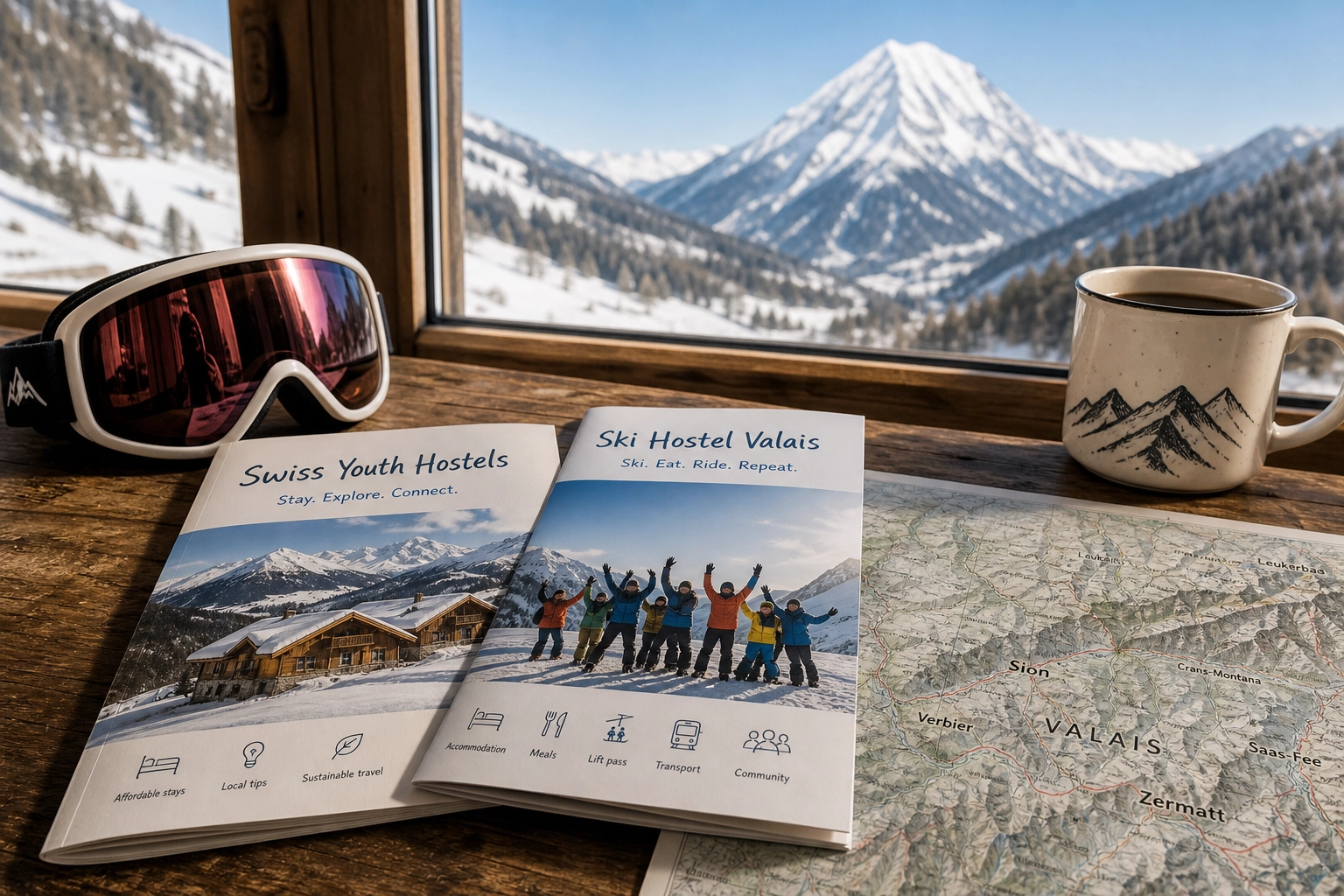
Planning a ski trip to the Swiss Alps usually begins with a jolt of financial reality. Switzerland offers some of the most spectacular high-alpine terrain on the planet, but it also carries a reputation for draining bank accounts with ruthless efficiency. For budget-conscious skiers, solo travelers, and digital nomads looking at the Valais region, the accommodation search quickly funnels down to two distinct paths: booking a bed in a traditional Swiss Youth Hostel and organizing the rest of the trip yourself, or booking a specialized, all-inclusive Ski Hostel package.
On the surface, both options promise an affordable way to access the mountains. But they operate on entirely different models. One is a highly standardized, flexible lodging platform; the other is a bundled winter ecosystem designed to strip away the mental load and hidden costs of alpine travel.
Understanding the structural differences between these two approaches will dictate not just how much you spend, but how you spend your time off the slopes.
The Traditional Route: Swiss Youth Hostels (Jugendherbergen)
Switzerland’s network of youth hostels is arguably the best in the world. If you are accustomed to the gritty, bare-bones hostels of other European capitals, the Swiss standard will shock you. These facilities are heavily standardized, meticulously clean, and often feature striking modern architecture.
In the Valais region, hostels in mega-resorts like Zermatt or Saas-Fee (home to the impressive WellnessHostel4000, which includes a full indoor pool and spa complex) provide budget travelers a way to sleep in towns that otherwise cater exclusively to luxury demographics.
The Ultimate A La Carte Experience
The primary advantage of a Swiss Youth Hostel is absolute independence. You are booking a bed and a breakfast. Everything else is up to you.
- Flexibility: You can book night-by-night, allowing you to chase storm cycles across different valleys or mix a few days of skiing with a few days of sightseeing in Bern or Zurich.
- Broad Demographics: Because they act as general budget infrastructure, Many Swiss hostels are part of the “Swiss Youth Hostels” network (Jugendherbergen). Membership can reduce nightly rates… aged 18-35, but all ages are welcome. You will share the breakfast hall with a wide mix of travelers: high school ski camps, retired hiking groups, backpacking families, and weekend warriors.
- Base Facilities: You can expect secure, heated boot and ski rooms, reliable lockers, and a hearty, carb-heavy continental breakfast buffet to start your day.
The Trade-off: The Mental Load of DIY
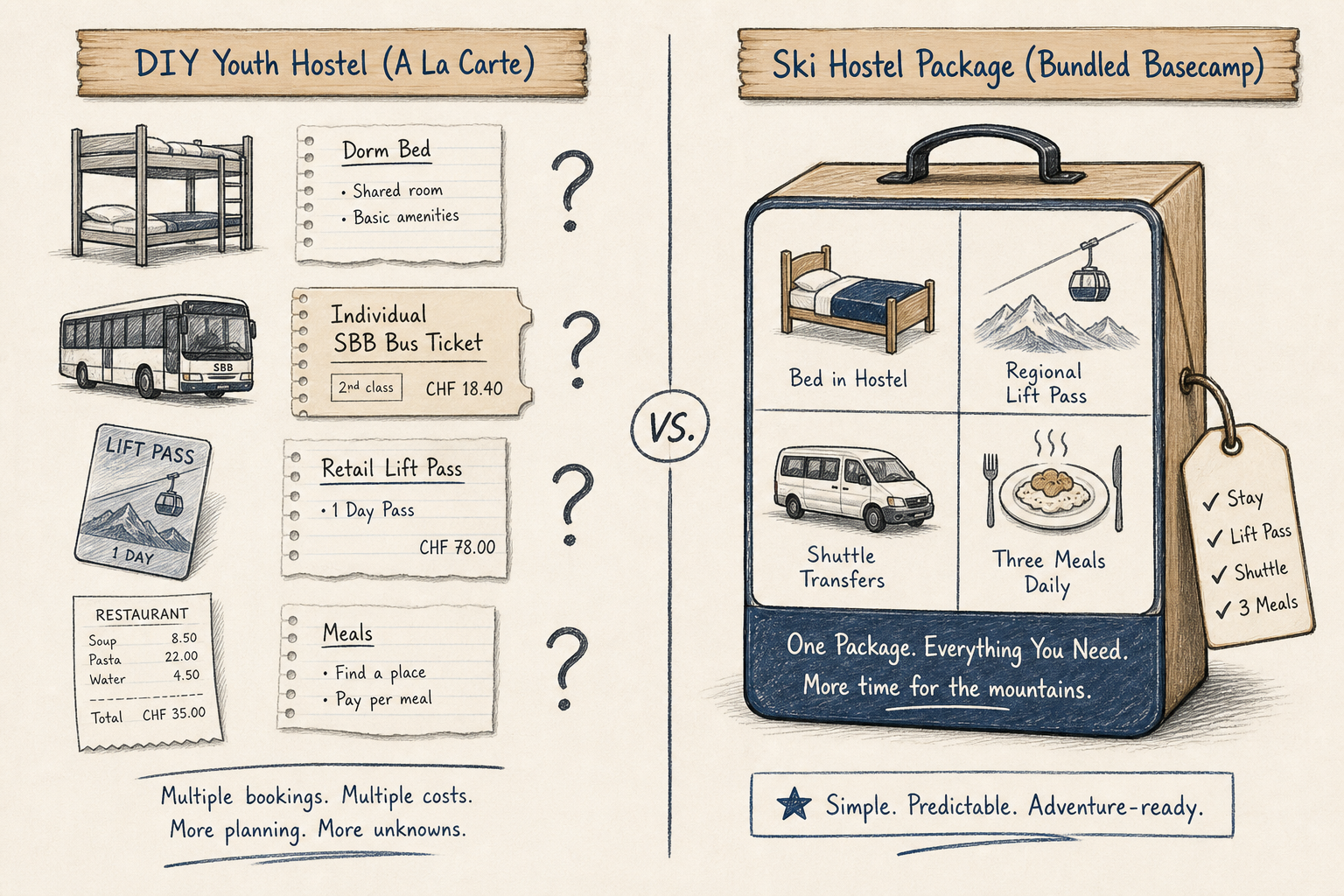
The flexibility of a standard youth hostel comes at the cost of logistics. When you book just a bed, you are stepping into the Swiss retail ecosystem for everything else. You must navigate the SBB train and PostBus schedules to get from the hostel to the lifts. You must purchase walk-up or dynamically priced ski passes. You have to hunt down affordable lunches on the mountain and dinners in town—a task that can quickly become exhausting in resorts where a basic pizza often exceeds CHF 25.
For a deeper dive into piecing these logistics together yourself, reviewing how to plan an affordable ski trip in the Swiss Alps can help you anticipate the necessary planning steps.
The Package Approach: Specialized Ski Hostels
A specialized ski hostel flips the traditional model. Instead of offering a cheap bed and leaving you to fend for yourself, it bundles the essential components of a ski holiday into a single, predictable package.
Ski Hostel, based at the Relais de Dranse in Liddes, operates on this exact model. Built for 6- or 7-night stays, it caters specifically to winter sports enthusiasts, solo travelers, and digital nomads who want the community of a hostel but the logistical ease of a resort package.
The Bundled Ecosystem
When you book a package at a specialized ski hostel, the transaction covers your entire operational footprint for the week.
- Included Lift Passes: Rather than paying premium daily rates at mega-resorts, packages typically utilize high-value regional mountains. Ski Hostel includes passes for three nearby Swiss Alps resorts: Vichères-Liddes, La Fouly, and Champex-Lac. These resorts offer excellent freeride terrain, tree skiing, and uncrowded pistes away from the chaotic bottlenecks of larger commercial mountains.
- Mountain Shuttles: You are not subject to the public PostBus schedule. Daily mountain shuttle transfers are built into the day, moving the house from the hostel to the designated resort for first tracks, and bringing everyone back when the lifts close.
- Full-Board Dining: This is arguably the most significant differentiator. Finding affordable food is the hardest part of Swiss travel. With breakfast, a packed mountain lunch, and a communal dinner included, your daily food expenditure drops essentially to zero unless you want a mid-afternoon beer on the slopes.
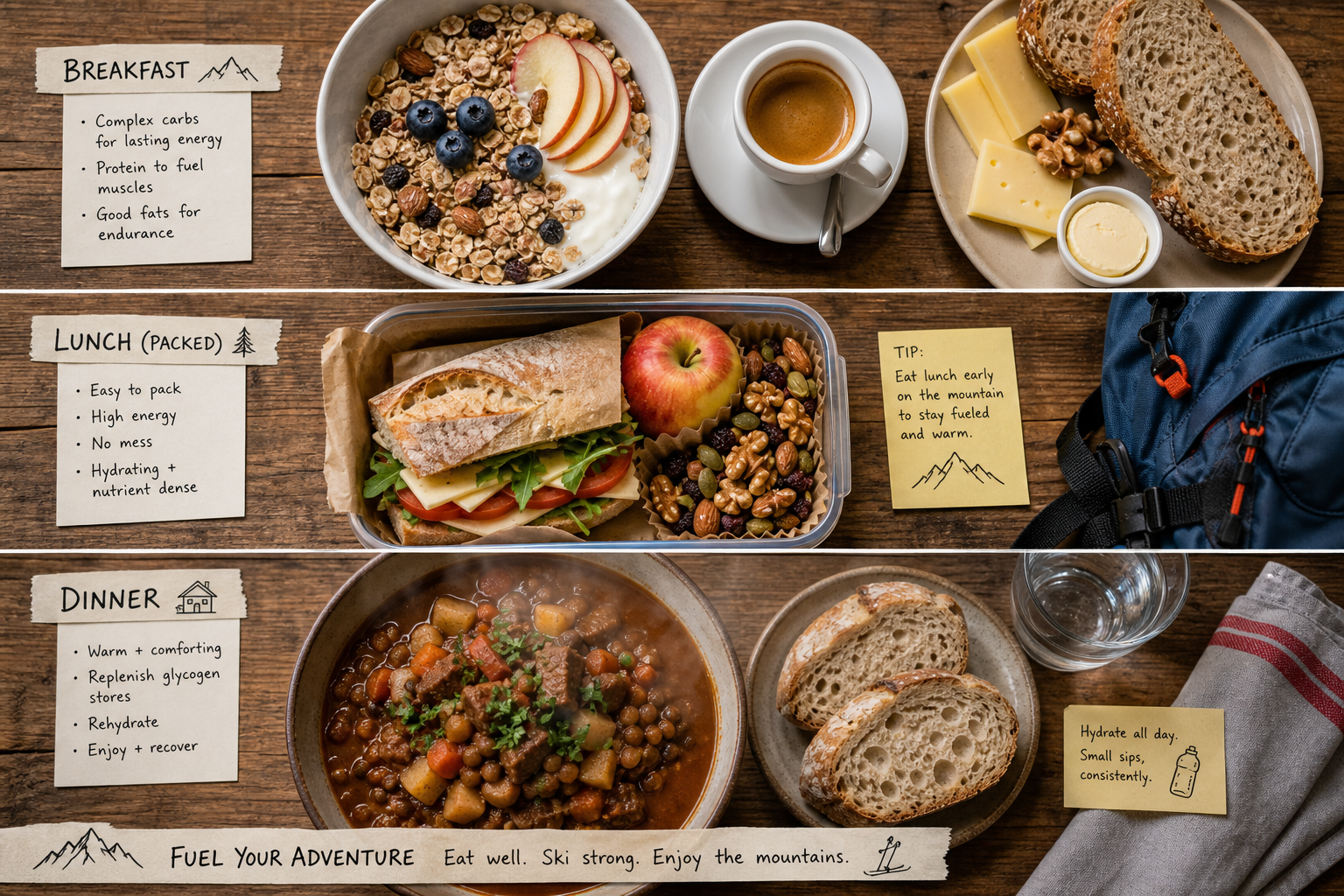
If you are debating whether you actually need lunch and dinner included in your lodging, looking at half board vs full board for an active ski holiday illustrates just how quickly a la carte dining drains a budget.
The Trade-off: Regional Commitment
The primary limitation of an all-inclusive ski hostel package is that you are committing to one specific region and a set timeframe. If your goal is to spend two days in Zermatt, two days in Verbier, and two days in St. Moritz, a centralized 7-night package in Liddes won’t fit your itinerary. The model is designed for travelers who want to unpack once, settle into a routine, and focus entirely on riding and relaxing rather than transit and logistics.
The True Cost of a Swiss Ski Week: Unbundling the Daily Spend
The most common mistake budget skiers make in Switzerland is optimizing purely for the cheapest nightly bed rate. They secure a hostel bed for CHF 55 a night and assume they have hacked the system.
This is a dangerous miscalculation. In ski towns, the bed is simply the entry fee. To understand the real financial difference, we have to look at the total daily operational cost.
| Expense Category | DIY Swiss Youth Hostel (e.g., Zermatt/Saas-Fee) | All-Inclusive Ski Hostel Package (Liddes) |
|---|---|---|
| Accommodation | CHF 50 - 80 per night | Included in package |
| Breakfast | Included | Included in package |
| Lift Pass | CHF 75 - 100+ per day | Included (Vichères-Liddes, La Fouly, Champex-Lac) |
| Lunch | CHF 20 - 35 (Mountain restaurant) | Included (Packed lunch) |
| Dinner | CHF 25 - 50 (In town) | Included (Communal dinner) |
| Local Transit | CHF 0 - 15 (PostBus / Train to lifts) | Included (Daily shuttle) |
| Estimated Daily Total | ~CHF 170 - 280+ per day | Fixed Package Rate |
Note: DIY estimates vary heavily based on the specific mega-resort and how strictly you adhere to grocery store sandwiches over restaurant meals.
When you compare ski hostel packages vs youth hostels in Valais, the financial predictability of the package model stands out. You know exactly what your week will cost before you even board your flight. The only variables left are equipment rentals—and if you are bringing your own gear, navigating what equipment to bring for a budget European ski trip ensures you avoid surprise baggage fees.
Community and Vibe: Who are you sharing the boot room with?
Lodging defines the social fabric of your trip, especially if you are traveling solo or working remotely as a digital nomad.
The Transient Mix of a Youth Hostel
Because a standard Swiss Youth Hostel is open to everyone and acts as a generic budget hub, the atmosphere is highly transient. You might share a dorm with a family of four from Germany, two backpackers from Australia who are in town just to see the Matterhorn, and a retired couple hiking the valley floors.
It is a fantastic way to meet people from all walks of life, but it does not guarantee you will find ski buddies. Everyone is on their own schedule, heading to different peaks, or not skiing at all.
The Hyper-Targeted Ski Hostel Community
A specialized ski hostel operates more like a winter basecamp. Because everyone there has purchased a 6- or 7-night ski package, the entire building is aligned on the exact same mission.
The daily routine creates a tight-knit community fast. You are all loading into the same mountain shuttle in the morning. You are riding the same localized resorts in the Pays du St-Bernard region. And crucially, you are all sitting down together for a communal full-board dinner in the evening.
For solo travelers, this eliminates the awkwardness of dining alone in expensive resort restaurants or struggling to find partners to explore off-piste terrain. For digital nomads, it offers a perfect balance: you can work quietly from the lounge or your room during the day, knowing that a lively, ready-made social circle will be waiting at dinner.
Logistics and Local Transport: Getting to the Powder
Valais is steep, expansive, and geographically complex. Getting from where you sleep to where the lifts start is a daily operational hurdle.
If you are staying in a standard youth hostel in a town like Sion or Brig (to save money over staying directly in Zermatt or Verbier), you are heavily reliant on the Swiss transit network. SBB trains and yellow PostBuses are incredibly punctual, but you are still hauling heavy skis, rigid boots, and bulky layers onto public transit. You must align your morning routine precisely with the bus schedule, and if you want to stay on the mountain for an après-ski beer, you have to carefully track the time of the last valley descent.
The Ski Hostel model removes this friction entirely. The inclusion of daily mountain shuttles means the logistics are handled by the staff. The shuttle acts as a private locker room extension—you load your gear, grab a seat, and get dropped off directly at the base of Vichères-Liddes or Champex-Lac. At the end of the day, the shuttle is waiting to bring you back to Liddes. You spend zero mental energy planning routes or checking timetables.
The “Hidden Costs” Myth in Swiss Skiing
There is a persistent myth that the only way to ski Switzerland on a budget is to endure miserable compromises: sleeping in grim quarters miles from the slopes, eating instant noodles for six days straight, and avoiding the mountain bars entirely.
This myth exists because travelers attempt to hack the traditional a la carte system. They try to artificially lower their daily spend by suffering.
The reality is that Swiss skiing is only ruinously expensive if you insist on participating in the luxury infrastructure of the mega-resorts. If you demand to ski Zermatt, eat fondue on the mountain, and drink craft cocktails at the base, you will pay a premium.
But if your priority is simply finding great snow, uncrowded terrain, and a warm place to sleep, the all-inclusive package model proves that Switzerland can be entirely reasonable. By shifting away from the famous mega-resorts to high-quality regional mountains, and bundling the lodging, food, and transport, the inflated costs of Swiss alpine tourism are bypassed completely.
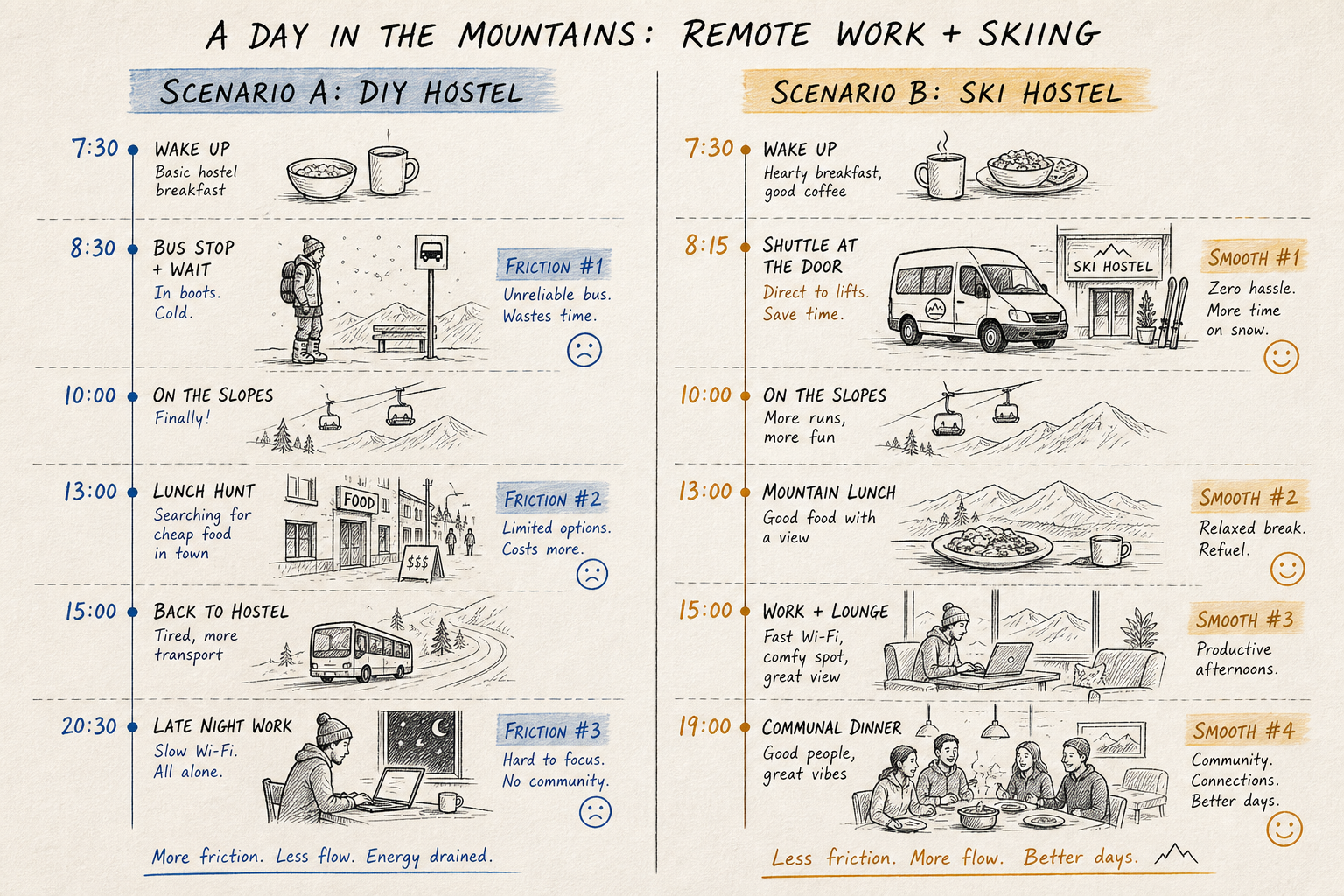
Case Scenario: Sarah’s Solo Ski Week in Valais
To understand how these two models play out in real life, consider a digital nomad named Sarah, who wants to ski for a week in January while maintaining a few hours of remote work each evening.
Scenario A: The DIY Youth Hostel
Sarah books a bed in a highly-rated youth hostel in a popular Valais resort town. She pays a great nightly rate. However, her mornings are frantic. She wakes up, rushes through the buffet, walks 15 minutes to the bus stop in her ski boots, and waits for the crowded ski bus. On the mountain, she pays CHF 85 for a day pass. At 1 PM, she is starving but refuses to pay CHF 30 for a burger, so she eats a squished sandwich she made in the hostel bathroom.
At 4 PM, she takes the bus back. She needs to work, but she also needs to eat dinner. She spends an hour walking around town looking for an affordable restaurant, eventually settling for an overpriced pasta dish. By the time she opens her laptop at 7:30 PM, she is exhausted from the logistical friction of the day.
Scenario B: The Ski Hostel Package
Sarah books a 7-night package at Ski Hostel in Liddes. She wakes up, eats breakfast, and steps directly into the waiting shuttle outside the front door. Her lift pass to La Fouly is already in her jacket pocket. At lunch, she eats the packed lunch provided by the hostel while sitting on a sunny terrace.
At 4 PM, the shuttle brings her back to Relais de Dranse. She immediately takes a shower, opens her laptop in the lounge, and works highly productively for three hours. At 7:30 PM, she closes her laptop and joins 15 other skiers for a hot, communal dinner that she didn’t have to plan, shop for, or cook. She spends the evening trading stories about the day’s conditions, completely stress-free.
Frequently Asked Questions
Should I stay at Swiss Youth Hostels or book a specialized Ski Hostel package in Valais?
It comes down to your travel style. If you want total itinerary flexibility, prefer to cook your own meals in a shared kitchen, and want to jump between famous mega-resorts like Zermatt and Verbier, a standard Swiss Youth Hostel gives you the freedom to build your own trip. If you want predictable costs, built-in ski buddies, and want to avoid the logistical nightmare of piecing together daily transport, lift tickets, and expensive Swiss meals, a specialized all-inclusive Ski Hostel package is the better choice.
Are lift passes included at standard Swiss Youth Hostels?
No. Standard youth hostels provide accommodation and typically breakfast. Some may occasionally offer minor discounts on regional passes if they have a partnership, but you are generally responsible for purchasing your own lift tickets at standard resort rates.
Which option is better for digital nomads?
Specialized ski hostels tend to be much more conducive to remote work. Because full-board dining and mountain shuttles run on a set schedule, digital nomads can easily structure their work blocks without having to interrupt their workflow to hunt for food, navigate grocery stores, or figure out public transit.
Do I need a car for either option?
You do not need a car for either. The Swiss train and PostBus network is incredibly robust, making it easy to reach traditional youth hostels. For Ski Hostel guests arriving in Valais, public transit will get you easily to Liddes, and from there, the included daily mountain shuttles handle all the driving to the specific local resorts. Optional airport transfers are often available to make arrival even smoother.
Choosing your basecamp in the Valais region ultimately defines your winter holiday. The traditional youth hostel offers a brilliant, clean slate for the fiercely independent traveler willing to manage the daily math of Swiss pricing. But for those who want to focus entirely on the snow, the camaraderie, and keeping their budget strictly contained, opting for a bundled ski hostel package offers a rare, friction-free way to experience the Alps.